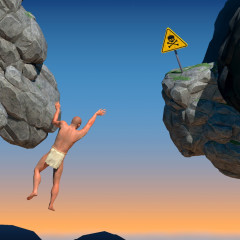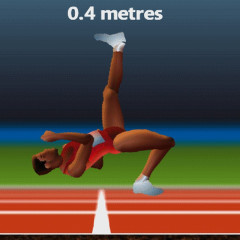
The character's unusually long legs are the central feature of the game. They create an unstable walking motion that requires careful control.
A normal character might take a step and remain relatively stable. In Daddy Long Legs, one step can shift the entire body forward or backward. The character may lean, wobble, or suddenly lose balance.
This unusual movement is what makes the game both funny and difficult. Spend your first few attempts learning how the body reacts to different timings rather than focusing immediately on achieving a high score.
New players often make the mistake of trying to move quickly from the beginning. Large or poorly timed movements can cause the character to fall before he has a chance to build momentum.
Start slowly and allow each step to develop. Watch where the feet land and notice how the body responds.
Once you understand the movement better, gradually increase your pace. Controlled steps are much more valuable than rushed actions.
The main goal of Daddy Long Legs is to help the long-legged character travel as far as possible. Every successful step adds distance, while a fall ends the current attempt.
The scoring system encourages you to keep improving your personal record. You do not need to complete a complicated mission; the challenge is simply to stay upright and continue moving forward.
Walking successfully depends on combining individual steps rather than trying to move too far at once.
After each movement, check the character's balance. When the body begins to lean, prepare your next input carefully instead of immediately making another large movement.
Think of the game as a sequence:
Step → Balance → Step → Balance → Step
This approach gives you more control over the character's unusual physics.
The key to a long run is combining steps smoothly. Each movement affects the next one, so you cannot treat every step as a completely separate action.
Try to make one step naturally lead into the next. Watch the position of the body and legs, then time your next input around the current balance.
When the character is stable, continue with your established rhythm. When he starts leaning too far, make a more careful adjustment.
A good walking sequence does not need to be perfectly symmetrical. Physics can create small differences between steps, so learning to adapt is more useful than following a rigid pattern.
Distance is the most important factor when you are trying to improve your score. Moving faster may seem attractive, but speed is useless when it causes an early fall.
Focus on staying upright first. Once you can consistently walk a reasonable distance, begin experimenting with faster movements.
This gradual approach makes it easier to improve without repeatedly losing progress because of rushed actions.
The long legs provide useful visual information. Pay attention to the position of each foot after a step.
A stable foot placement usually gives the body a better chance to remain balanced. An awkward landing may require a quick adjustment.
By watching the legs carefully, you can start predicting what is likely to happen after your next input.
Not every wobble leads to a fall. Sometimes the character can recover from an awkward position with a carefully timed movement.
When you notice the body leaning, avoid panicking. Give yourself a moment to understand the direction of the movement.
A rushed input may make the imbalance worse. A controlled adjustment can sometimes bring the character back into a stable position.
Falling is a normal part of Daddy Long Legs. Because the physics are unusual, it can take several attempts to understand the correct timing.
After each failed run, think about what happened immediately before the fall. Did the character lean too far? Did the next step come too quickly? Was the previous foot placed in an unstable position?
Use the answer to change your next attempt. Small corrections can gradually turn short runs into much longer ones.
A steady rhythm makes the character easier to control. Try to develop a pattern that allows you to make progress without constantly correcting your movement.
Your rhythm does not have to be extremely fast. Stability should remain the priority.
The beginning of a run gives you time to establish control. Use it to find a comfortable pace before attempting to move faster.
A stable start can make the rest of the run easier to manage.
It is tempting to focus on the distance counter or imagine how far you want to go. However, the character's movement gives you the most useful information.
Watch the legs, body angle, and foot placement. These details can tell you when another movement is safe.
Large corrections can make the character even more unstable. When possible, make small changes to your timing.
Gradual adjustments are especially helpful when you are already close to your personal best.
Daddy Long Legs is designed around unpredictable physics. Some attempts will be short, even after you have learned the basic mechanics.
Do not let a quick fall discourage you. Restart, remember what went wrong, and try a slightly different approach.
Players who enjoy games where simple mechanics become challenging through clever design may also enjoy Level Devil. Its platforming challenges use unexpected obstacles and surprising level changes to create a very different type of difficulty.