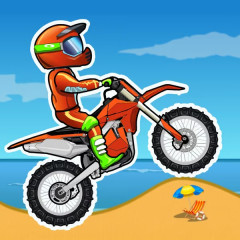
Distance is the central objective in Mountain Bike Xtreme. Every stretch of terrain you successfully cross brings you closer to a better result, but the route requires patience and accurate control. You must keep moving forward while ensuring the bicycle does not flip over or fall into gaps.
Balancing is one of the most important parts of Mountain Bike Xtreme. The bicycle constantly responds to the shape of the ground, and a steep incline or sudden drop can change its angle quickly. Without careful adjustments, the front or rear wheel may rise too far, causing the bicycle to flip.
Use the left and right arrow keys to adjust the bike's position as you move. When approaching a slope, pay attention to the angle of the frame and make small corrections before the bicycle becomes unstable. Smooth adjustments usually provide better control than holding one direction for too long.
The terrain also affects how you should balance. Riding uphill may require a different approach from descending a steep slope. Rather than using the same movement pattern everywhere, observe how the bicycle responds and adjust your inputs to match the situation.
Here are some practical tips for maintaining balance:
Make small adjustments: Avoid sudden, excessive movements that can destabilize the bicycle.
Watch the bike's angle: Pay attention to whether the front or rear wheel is rising too far.
Prepare for slopes: Adjust your balance before reaching steep sections rather than waiting until the bike is already tilted.
Stay calm after a bump: Correct the bicycle's position carefully instead of reacting with unnecessary movements.
Prioritize stability: A controlled ride is more likely to cover a long distance than an aggressive run that ends quickly.
The more familiar you become with the controls, the easier it will be to recognize when the bicycle needs a correction. Over time, balancing becomes a natural part of navigating the terrain.
Flipping over is one of the main risks in Mountain Bike Xtreme. The bicycle can become unstable when its front or rear wheel rises too far, particularly when moving over steep slopes or uneven ground. A crash can end your current attempt and force you to start again.
To reduce this risk, avoid making large balance adjustments without considering the bicycle's current position. The left and right arrow keys should be used to correct the angle gradually. A short adjustment may be enough to keep the bicycle stable, while excessive input can make the situation worse.
Speed also affects how you approach dangerous terrain. Moving quickly over a bump can make the bicycle tilt unexpectedly, leaving little time to correct its position. Adjust your forward movement when necessary and focus on keeping the wheels under control.
A useful habit is to watch the bicycle rather than looking only at the distance you have traveled. Your current position provides important information about whether you need to lean forward, lean backward, or reduce movement. Paying attention to these details can help you prevent crashes and maintain a longer run.
Gaps are another major obstacle in Mountain Bike Xtreme. These openings interrupt the route and can cause the bicycle to fall if you approach them without enough control. Since the goal is to travel as far as possible, avoiding gaps is essential for achieving a strong result.
Look ahead whenever the terrain allows you to see the upcoming path. Recognizing a gap early gives you more time to adjust your movement and prepare the bicycle for the transition. Rushing toward an opening without considering the bike's position can quickly end your attempt.
When approaching a gap, concentrate on keeping the bicycle stable. Avoid unnecessary leaning that could cause the front wheel to rise too high or the frame to become unbalanced. The exact adjustment depends on the shape of the terrain, so pay attention to how the bicycle responds as you move.
After crossing a gap or landing on uneven ground, check the bicycle's angle immediately. A landing can leave the bike tilted, making the next obstacle more dangerous. Correcting the position early helps you regain control before continuing along the route.
Balance is essential, but movement control also plays a major role in Mountain Bike Xtreme. You need enough forward movement to continue along the course while avoiding excessive speed that makes difficult sections harder to handle.
The up arrow key helps you move forward, while the down arrow key can be used to manage backward movement or adjust your movement as needed. Learning when to use each control can make your ride more consistent.
Moving forward continuously may work on relatively smooth ground, but uneven terrain requires more attention. Steep slopes and sudden changes in elevation can make the bicycle unstable, so be ready to adjust your movement when the landscape becomes more challenging.
Rather than treating every section as a race, approach each part of the course according to its shape. Smooth stretches provide an opportunity to make progress, while difficult sections call for more careful control. This balance between movement and stability helps you avoid unnecessary crashes.
The arrow keys are most effective when you understand how they work together. Forward movement helps the bicycle cover distance, while left and right inputs control its angle. Focusing on only one aspect can make it harder to handle difficult terrain.
For example, accelerating while the bicycle is already tilted at an unsafe angle may increase the chance of flipping. Correcting the angle before continuing can help you regain control. Similarly, balancing carefully without making forward progress will not help you reach a greater distance.
The aim is to develop a rhythm that combines steady movement with timely corrections. Observe the terrain, manage your speed, and adjust the bicycle's position whenever necessary. With practice, you will become more comfortable responding to different slopes and gaps.
A crash does not mean your entire session was wasted. Each failed attempt can teach you something about the terrain, the controls, or the way the bicycle reacts to certain movements.
Think about what happened just before the crash. Did the bicycle flip after crossing a bump? Did you approach a gap at an unsafe angle? Were you holding a balance key for too long? Identifying the cause makes it easier to change your approach during the next run.
Try to adjust one part of your strategy at a time. You might use less forward movement on a steep slope or make smaller balance corrections near a gap. This process helps you understand which actions improve stability and which ones create unnecessary risks.
Repeated practice gradually builds better timing and control. Even when you do not achieve a new distance record, learning to handle a difficult section more consistently is meaningful progress.
Players who enjoy controlling vehicles may also appreciate Uphill Bus Simulator 3D, which offers a different kind of driving experience. Instead of balancing a bicycle over rugged terrain, you take control of a bus and navigate uphill routes that require careful steering and vehicle management.
The two games offer different challenges, but both reward players who pay attention to the terrain and maintain control of their vehicles. Mountain Bike Xtreme focuses on bicycle balance and distance, while Uphill Bus Simulator 3D provides an opportunity to explore driving challenges with a larger vehicle.
Trying both games can add variety to your browser gaming sessions. One lets you test your balance on uneven paths, while the other shifts the focus toward maneuvering a bus across demanding uphill routes.